
For decades, the skincare world has had one undisputed king: Retinol. A derivative of Vitamin A, Retinol is praised by dermatologists for its ability to speed up cell turnover, fade hyperpigmentation, and kickstart collagen production.
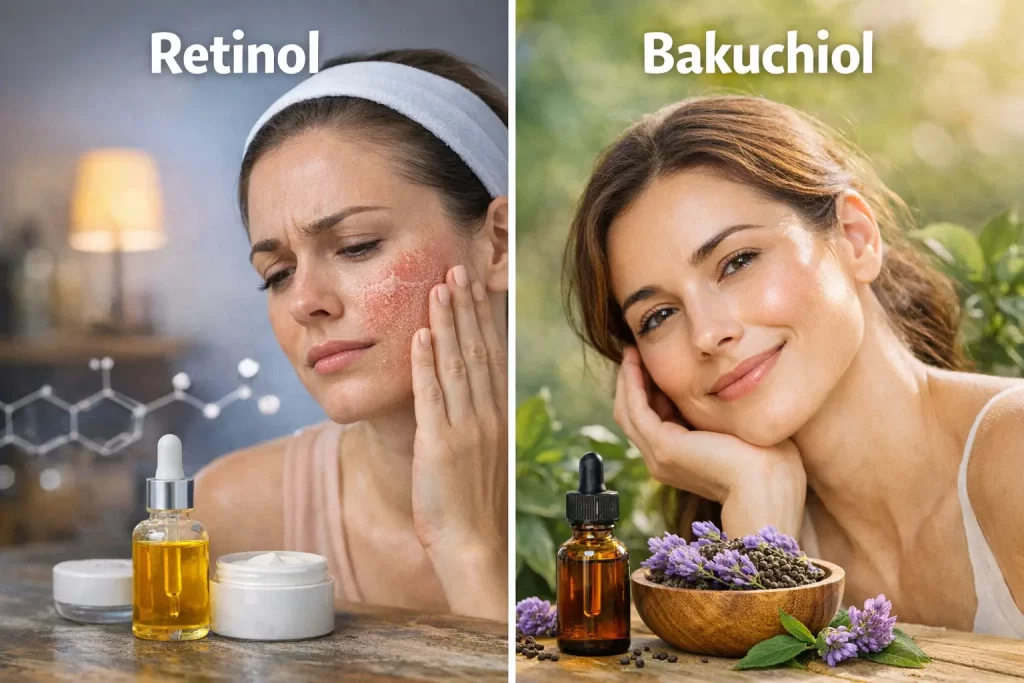
But there is a dark side to the king. For many, Retinol brings the “Retinol Uglies”—a grueling weeks-long period of flaking, redness, and a stinging skin barrier.
Enter Bakuchiol. Extracted from the seeds and leaves of the Psoralea corylifolia (Babchi) plant, this botanical powerhouse is being hailed as the “natural retinol.” But can a plant really compete with a pharmaceutical-grade active? Let’s dive into the science of bio-compatible repair.
The Molecular Matchup: How They Work
Interestingly, Bakuchiol and Retinol do not look alike at a molecular level. However, a landmark 2018 study published in the British Journal of Dermatology found that they behave like “biological twins” once they hit your skin.
Retinol: The Aggressor
Retinol works by converting into retinoic acid in the skin. This acid binds to nuclear receptors to trigger cell behavior. Because this conversion process is intense, it often causes “retinoid dermatitis”—inflammation that can actually accelerate aging if not managed correctly.
Bakuchiol: The Messenger
Bakuchiol doesn’t need to convert. It triggers the same gene expression for types I, II, and IV collagen as Retinol does, but it skips the inflammatory pathway. Instead of forcing the skin to change through irritation, it “reminds” the skin how to repair itself.
The Side-by-Side Comparison
| Feature | Retinol | Bakuchiol |
| Collagen Synthesis | High | High |
| Irritation Level | High (Peeling/Redness) | Low (Soothing) |
| Photo-Stability | Low (Degrades in sun) | High (Can be used in AM) |
| Barrier Impact | Can thin the barrier initially | Strengthens the barrier |
| Pregnancy Safe | No | Yes |
Why Bakuchiol Wins for “Conscious Anti-Aging”
In our Conscious Anti-Aging Framework, we prioritize longevity over instant (but damaging) results. Bakuchiol fits this perfectly for three reasons:
- Antioxidant Protection: Bakuchiol is a potent antioxidant that helps protect skin lipids (like the ones we discuss in our Winter Survival Guide) from oxidizing.
- No Photosensitivity: Unlike Retinol, which makes your skin more vulnerable to UV damage, Bakuchiol is photostable. It actually helps protect the skin from sun-induced redness.
- Microbiome Friendly: Because it doesn’t cause mass peeling, it leaves your Acid Mantle intact, keeping your skin’s natural defense system strong.
Recommended Bakuchiol Essentials
Experience the power of phyto-retinols with these bio-compatible, high-performance picks:
The Targeted Serum: Medik8 Bakuchiol Peptides
This is a professional-grade alternative to Vitamin A. It combines 1.2% pure Bakuchiol with brightening peptide precursors and calming centella asiatica. It is specifically formulated for those who cannot tolerate Retinol but want clinical results.
The Nightly Oil: Burt’s Bees Renewal Intensive Firming Serum
A testament to the power of clean beauty, this serum uses Bakuchiol to improve the appearance of deep lines and wrinkles while being incredibly nourishing. It’s an accessible entry point into the world of phyto-retinols.
The Multi-Tasker: Ole Henriksen Goodnight Glow Retin-ALT Sleeping Creme
This rich night cream pairs Bakuchiol with AHAs (Alpha Hydroxy Acids) like Edelweiss stem cell extract. It gently exfoliates while it repairs, giving you a “Retinol glow” by morning without the Retinol sting.
How to Switch from Retinol to Bakuchiol
If you are currently struggling with Retinol, you don’t have to quit anti-aging altogether.
- The Transition: You can actually use them together to “buffer” the Retinol, or swap your Retinol nights for Bakuchiol nights entirely.
- The Routine: Apply your Bakuchiol serum after your pH-Balanced Cleanser and before your Ceramide-Rich Moisturizer.
Conclusion: Repair Without Despair
You no longer have to choose between having a healthy skin barrier and having youthful-looking skin. Bakuchiol proves that bio-compatibility is the future of anti-aging. By choosing a plant-based messenger over a chemical aggressor, you are investing in the long-term resilience of your skin.
Affiliate Disclaimer: As an expert resource, we recommend products that meet our high standards for bio-compatibility. If you purchase through our links, we may earn a small commission at no extra cost to you.