
Have you ever turned over a luxury face cream, looked at the ingredient list (the INCI), and felt more confused than when you started? You aren’t alone. Between the long botanical names and the complex chemical compounds, it’s hard to tell if a product is truly “bio-compatible” or just cleverly marketed.
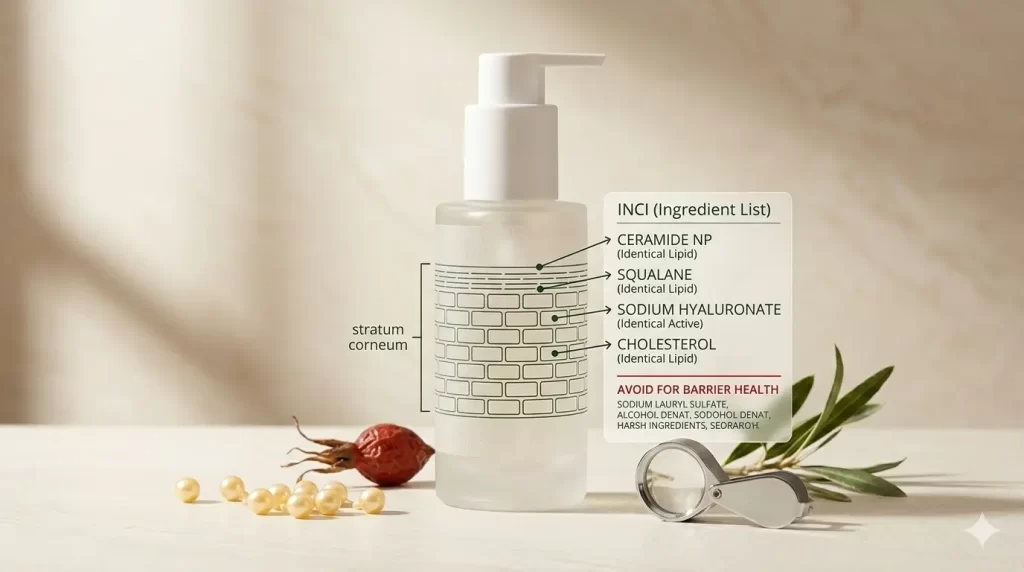
If your goal is to repair your skin barrier, you need to look for Skin-Identical Ingredients. These are substances already found naturally in your skin. When applied topically, your skin recognizes them as “self” rather than “foreign,” allowing for deeper integration and faster repair.
The “Big Three” of Bio-Compatibility
To truly support the skin’s architecture, a product should ideally contain a combination of these three lipid types. On a label, they will look like this:
1. Ceramides (The Glue)
On the label, these are easy to spot but often come in different “flavors.”
- Look for: Ceramide NP, Ceramide AP, Ceramide EOP, Ceramide NG, Phytosphingosine.
- Why they matter: They make up 50% of your skin’s composition. If these aren’t in the top half of the ingredient list, the product may not have enough to actually move the needle on barrier repair.
2. Fatty Acids (The Nutrients)
These are often hidden within plant oils or listed by their chemical names.
- Look for: Linoleic Acid, Linolenic Acid, Oleic Acid, Stearic Acid, Palmitic Acid.
- Natural Sources: Helianthus Annuus (Sunflower) Seed Oil, Borago Officinalis (Borage) Seed Oil.
3. Cholesterol (The Stabilizer)
Don’t be afraid of this word! In skincare, cholesterol is a vital stabilizer for the skin barrier.
- Look for: Cholesterol or Phytosterols (the plant-derived version).
- Why it matters: Without cholesterol, ceramides cannot organize themselves into the “mortar” that keeps moisture locked in.
Other Key Skin-Identical Actives
Beyond lipids, there are other molecules your skin produces naturally that you should look for on a label:
- Natural Moisturizing Factors (NMFs): Look for Urea, Sodium PCA, Lactic Acid, and Amino Acids (like Arginine or Glycine). These keep the “bricks” of your skin hydrated.
- Squalane: As discussed in our blog: The Ultimate Guide to Skin Barrier Health, ensure it is listed as Squalane (the stable version) rather than Squalene.
- Hyaluronic Acid: Usually listed as Sodium Hyaluronate. This is the salt form and is more bio-compatible due to its smaller molecular size.
Red Flags: What to Avoid for Barrier Health
If you are trying to repair your skin, certain ingredients can “undo” the work of the skin-identical lipids. Look out for:
- Denatured Alcohol: Often listed as Alcohol Denat. or Isopropyl Alcohol. It thins the lipid layer to make products feel “weightless,” but it’s the enemy of a healthy barrier.
- Essential Oils in High Concentrations: While “natural,” oils like Limonene, Linalool, and Peppermint Oil contain volatile compounds that can trigger inflammation in a compromised barrier.
- High-Foam Surfactants: Avoid Sodium Lauryl Sulfate (SLS). It’s too effective at removing oils, taking your natural ceramides down the drain with the dirt.
Recommended “Label-Approved” Essentials
These products pass the “INCI Test” with high concentrations of skin-identical ingredients:
The Comprehensive Serum: Paula’s Choice Omega+ Complex Serum
This serum is a masterclass in label transparency. It features a concentrated blend of omega fatty acids, three types of ceramides, and skin-identical cholesterol. It’s designed specifically to feed “starving” skin.
- Why we love the label: The ceramides and fatty acids are near the top of the list, ensuring efficacy.
The Barrier Stabilizer: SkinCeuticals Triple Lipid Restore 2:4:2
This is the gold standard for many dermatologists. The “2:4:2” refers to the specific, patented ratio of ceramides, cholesterol, and fatty acids. It is one of the most bio-compatible formulas on the market today.
- Why we love the label: It uses pure, high-potency lipids that mirror the skin’s natural age-related depletion.
The NMF Booster: The Ordinary Natural Moisturizing Factors + HA
A no-frills, highly effective cream that focuses entirely on NMFs. It contains 11 amino acids, phospholipids, and saccharides that are found naturally in the skin.
- Why we love the label: It’s a clean, simple formula that acts as a “supplement” for your skin’s natural hydration.
Pro-Tip: The Order Matters
Remember that ingredients are listed in order of concentration. If “Ceramide NP” is the very last ingredient on a list of 40, it’s likely only there for marketing purposes (this is called “fairy dusting”). For a product to be a true “barrier repair” cream, your skin-identical ingredients should appear in the first third of the list.
Conclusion: Become Your Own Ingredient Expert
Deciphering a label takes practice, but once you know what to look for, you’ll never be fooled by “clean-washing” again. Look for the lipids, prioritize NMFs, and always check the ratio.
For a deeper dive into how these ingredients work together to stop moisture loss, head back to our blog: The Ultimate Guide to Skin Barrier Health.
Disclaimer: As an expert resource, we recommend products that meet our high standards for bio-compatibility. If you purchase through our links, we may earn a small commission at no extra cost to you.