
Vitamin C is the undisputed superstar of the skincare world. If you were to ask any dermatologist for their “Top 3” essential ingredients, Vitamin C would almost certainly be on that list, sandwiched between sunscreen and retinoids. It is a biological powerhouse: a potent antioxidant, a mandatory cofactor for collagen synthesis, and a master at inhibiting melanin production to fade dark spots.
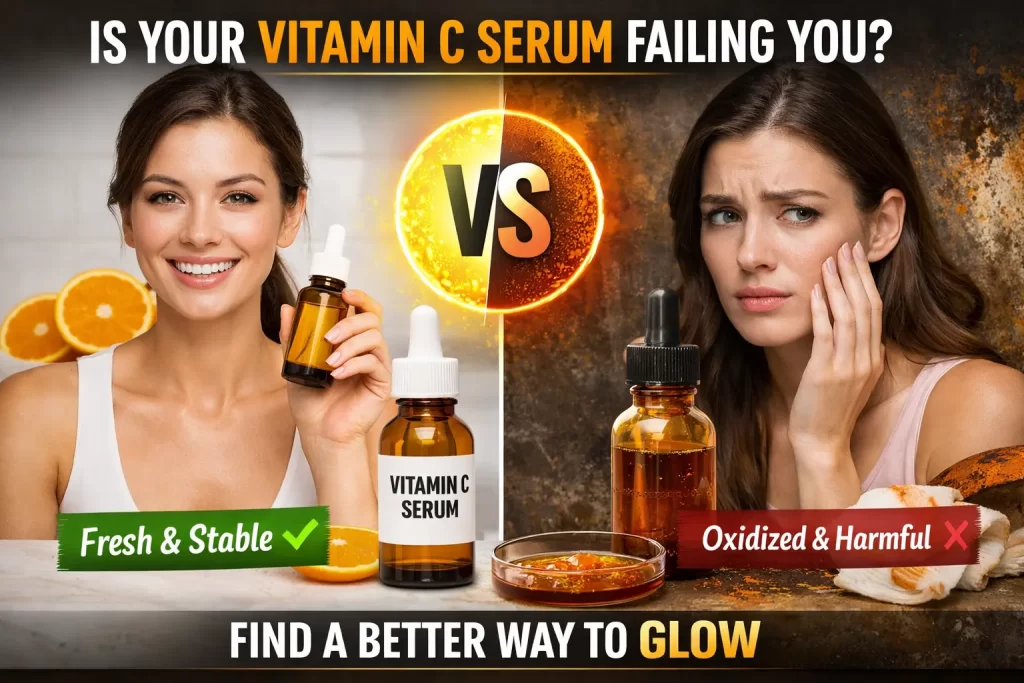
However, Vitamin C is also the most volatile, fussy, and prone-to-failure ingredient in your cabinet. For the “conscious” consumer—especially those with sensitive barriers—traditional Vitamin C is often a nightmare of irritation, orange-stained pores, and “metallic” odors.
In this comprehensive guide, we are going to explore why most Vitamin C serums fail, the hidden dangers of oxidation, and why bio-compatible, lipid-soluble derivatives are the only way to achieve a “Conscious Glow.”
Part I: The Chemistry of the “Diva” Molecule
To understand why your Vitamin C isn’t working, we have to look at its molecular structure. Traditional Vitamin C is known as L-Ascorbic Acid (LAA). While LAA is the most biologically active form, it is also “hydrophilic” (water-loving) and extremely unstable.
1. The Oxidation Trap
L-Ascorbic Acid is a scavenger. Its entire job is to “give away” an electron to neutralize a free radical (unstable molecules from UV or pollution). The problem? It doesn’t wait to get on your skin to start doing this. The moment you open the bottle, the LAA begins reacting with the oxygen in the air and the light from your window.
How to tell if your serum has oxidized:
- Color Change: It shifts from clear to pale yellow, then to amber, and finally to dark orange or brown.
- The Smell: It develops a distinct “hot dog water” or metallic scent.
- The Texture: It may feel grainier or leave a sticky film that turns your pores orange.
2. The Pro-Oxidant Danger
This is the part most brands won’t tell you: Oxidized Vitamin C is worse than no Vitamin C at all. Once L-Ascorbic Acid has turned orange, it has become a “pro-oxidant.” Instead of neutralizing free radicals on your skin, it can actually create oxidative stress, leading to premature aging and barrier inflammation.
3. The Acid Paradox
To make L-Ascorbic Acid penetrate the skin, chemists have to drop the pH of the serum to 3.5 or lower. For reference, your healthy skin barrier (your Acid Mantle) sits at a 5.5. Applying a pH 3.0 serum every morning is like applying a mild acid peel daily. For someone with a compromised barrier, this leads to chronic redness, stinging, and “micro-inflammation.”
Part II: The Bio-Compatible Hero—THD Ascorbate
If you have sensitive skin or are focused on barrier repair, you need to move away from water-based L-Ascorbic Acid and move toward Tetrahexyldecyl (THD) Ascorbate.
THD Ascorbate is a specialized, lipid-soluble derivative of Vitamin C. Unlike LAA, which is water-based, THD Ascorbate is fat-based. This simple change in “solubility” changes everything for your skin.
1. Superior Penetration
Your skin’s outermost layer is made of lipids (fats). Water-based serums struggle to get past this “oil slick.” THD Ascorbate, however, is “lipophilic.” It marries with your skin’s natural oils and slips effortlessly through the barrier, reaching the dermis—where collagen is actually produced—up to 3x more effectively than traditional Vitamin C.
2. Radical Stability
THD Ascorbate is incredibly stable. Because it is an “ester,” the active Vitamin C molecule is protected by a chemical “shield” that only breaks down once it is inside your skin. This means a bottle of THD Ascorbate can stay clear and potent for over a year, even if stored in a clear bottle.
3. pH Neutral Repair
Because THD Ascorbate is lipid-based, it doesn’t need a low pH to work. It is typically formulated at a pH of 5.5 to 6.5—the exact same level as your skin. No stinging, no redness, and no barrier disruption.
Part III: The Synergistic Shield (C + E + Ferulic)
Vitamin C never works alone in nature. In a citrus fruit, Vitamin C is surrounded by other antioxidants that keep it stable. In a “Conscious Anti-Aging” routine, we mimic this synergy.
- Vitamin E (Tocopherol): Vitamin C and E are “best friends.” When Vitamin C neutralizes a free radical, it becomes “spent.” Vitamin E actually “recharges” the Vitamin C molecule so it can keep fighting.
- Ferulic Acid: Found in the cell walls of plants like rice and oats, Ferulic Acid doubles the photo-protection capacity of Vitamin C and stabilizes the formula against light damage.
- Plant-Based Lipids: As we discussed in our Winter Survival Guide, suspending your Vitamin C in rich oils like Marula or Jojoba provides the “seal” that keeps the antioxidant from evaporating.
Part IV: Recommended Bio-Compatible Essentials
If you are ready to ditch the “Retinol-burn” style of Vitamin C and move to a stable, glowing routine, these are our top picks:
The Gold Standard: Biossance Squalane + Vitamin C Rose Oil
This is the ultimate example of conscious formulation. It uses THD Ascorbate (the stable one) suspended in sugarcane-derived Squalane. It brightens, firms, and hydrates simultaneously. It’s a “dry oil” that sinks in instantly and never turns orange on the skin.
The Potency Powerhouse: Sunday Riley C.E.O. 15% Vitamin C Brightening Serum
If you want the highest possible concentration of THD Ascorbate, this is it. It’s a creamy, non-acidic serum that targets dark spots and “tech-neck” lines without any irritation. It’s particularly effective for those with mature or sun-damaged skin.
The Barrier-First Choice: Paula’s Choice C5 Super Boost Moisturizer
By combining 5% Vitamin C with Hexapeptide-5 and lipids, this moisturizer treats Vitamin C as a “support” ingredient rather than an “aggressor.” It’s the perfect entry point for someone whose skin usually “hates” Vitamin C.
Part V: How to Use Vitamin C Without the “Sting”
- Morning Application: Your skin needs antioxidants most when it is under attack from UV rays. Apply your Vitamin C after your pH-Balanced Cleanser every morning.
- Wait for Dryness: If you are using a water-based Vitamin C, ensure your skin is completely dry. Water on the skin can increase the “acidic bite” of the serum.
- The “Antioxidant Sandwich”: If you are very sensitive, apply a light layer of moisturizer first, then your Vitamin C. This “buffers” the ingredient and prevents it from hitting the barrier too fast.
- Check Your Neck: Vitamin C is essential for the neck and chest, where the skin is thinner and shows sun damage early. Because these areas have fewer oil glands, they are more prone to “L-Ascorbic Acid” irritation—making THD Ascorbate even more important here.
Conclusion: Investing in Long-Term Radiance
Skincare should not be a battle. If your Vitamin C serum makes your skin red, it is contributing to “Inflammaging”—the process where chronic inflammation accelerates the aging process.
By switching to a stable, lipid-soluble, and bio-compatible Vitamin C, you are moving away from “fast-fix” aesthetics and toward long-term skin health. You get the collagen, you get the glow, and you keep your barrier intact.
Ready to learn more about the peptides that pair perfectly with Vitamin C? Check out our guide on Copper Peptides for Skin Elasticity.
Affiliate Disclaimer: As an expert resource, we recommend products that meet our high standards for bio-compatibility. If you purchase through our links, we may earn a small commission at no extra cost to you.